


Ventmaster Kiln Venting System
Downdraft fume extraction for Woodrow MK kilns. The Ventmaster draws kiln fumes down through the chamber and out a 100 mm duct to the outside, so they don’t linger in your kiln room. It runs automatically with every firing.
$1,496
Includes GST. Factory fitted — order it with a new MK kiln.
Key Features
The Ventmaster is a downdraft fume extraction system, fitted to your MK kiln at our Dapto factory. A small fan under the kiln keeps the chamber at a slight negative pressure, so fumes and odours are drawn out at the source and vented outside — they don’t linger in your kiln room.
How it works
-
Fresh air in — room air enters through the small hole in the roof bung.
-
Down through the chamber — air and fumes are drawn gently downward past your work.
-
Out through the floor — they leave through the extraction tube in the centre of the kiln floor.
-
Cooled with room air — the collector cup mixes in room air, so the exhaust stays below 75 °C.
-
Vented outside — the blower pushes it out the rear outlet and along a 100 mm duct to the outdoors.
At a glance
-
Fitting: factory fitted — order it with a new kiln
-
Models: MyKiln range, MK60 to MK500
-
Airflow: about 35 L/sec (2,067 L/min)
-
Ducting: 100 mm PVC to outside, up to 30 m
-
Exhaust: mixed with room air to stay below 75 °C
-
Operation: runs automatically with the kiln program
Supplied with your kiln
-
Blower and collector cup, factory fitted
-
About 1 m of black hose and two clamps
-
Roof bung with centre hole, and a solid door bung
-
Brick feet for the floor shelf, and a brick block
For fumes, not smoke
The Ventmaster is for normal kiln fumes and odours only — not smoke, fire control or general room ventilation. Investigate any visible smoke before firing again.
Benefits
Fumes and odours vented outside, not into the room
Carries moisture and corrosive gases out of the kiln
A gentle downdraft helps even out temperatures
Can help the kiln cool down after a firing
Runs automatically with every firing

Installation
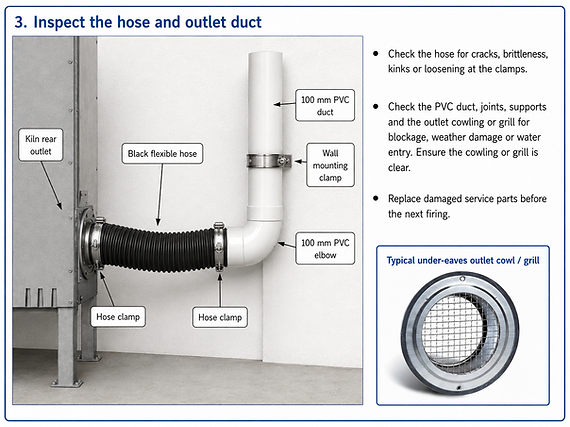
The Ventmaster is fitted at our factory to new MyKiln models, MK60 to MK500 — order it with your kiln. On site, your installer connects the rear outlet to a fixed 100 mm PVC duct that vents outdoors. Don’t fire until that duct is connected, and never vent into a ceiling, roof space or corridor.
Your installer supplies
Rigid 100 mm PVC duct, fittings and wall clamps
A weatherproof, non-restrictive outlet cowl
The wall or roof penetration and fire-stopping
A make-up air vent, if the room needs one
Duct length limits
Up to 30 m with no bends. Each 90° bend takes about 3 m off — 27 m with one bend, 24 m with two, 21 m with three and 18 m with four. Two 45° bends count as one. Measure from the kiln outlet to outside, including the hose. Need more? Ask us first.
Installation essentials
Smooth PVC all the way — no reducers or metal duct; kiln fumes are corrosive.
Keep the black hose short — under 1 m, and don’t coil, kink or stretch it.
Support the duct — clamp it to the wall so there’s no load on the kiln.
Vent to open air — away from windows and intakes, with a weatherproof cowl.
Let fresh air in — the room needs make-up air. Schools: use a low-level grille.
One duct per kiln — never join kilns into a shared duct.
Room heat is separate — enclosed rooms may need their own exhaust fan.
Every firing
Raise the floor shelf on the supplied brick feet so the centre extraction hole stays clear.
Fit both bungs — the bung with the hole goes in the roof, the solid bung in the door.
Bisque firings: once the kiln glows (about 600–750 °C), cover the roof bung with the brick block.
Simple care
Before each firing, check the hose is clamped, the outside cowl is clear and the room’s make-up air is open. Monthly or every 10 firings, vacuum loose dust with the kiln cold and the power off, and check the hose for cracks or kinks. We recommend a technician inspection every 12 months, especially for schools — the fan and hose are service parts.
Stop and call us before the next firing if you notice:
Stronger odours or visible fumes in the room
Little or no airflow at the outside outlet
Rattling, grinding or a fan that won’t start
Water or residue in the hose or duct


